Computer Systems for Physical AI
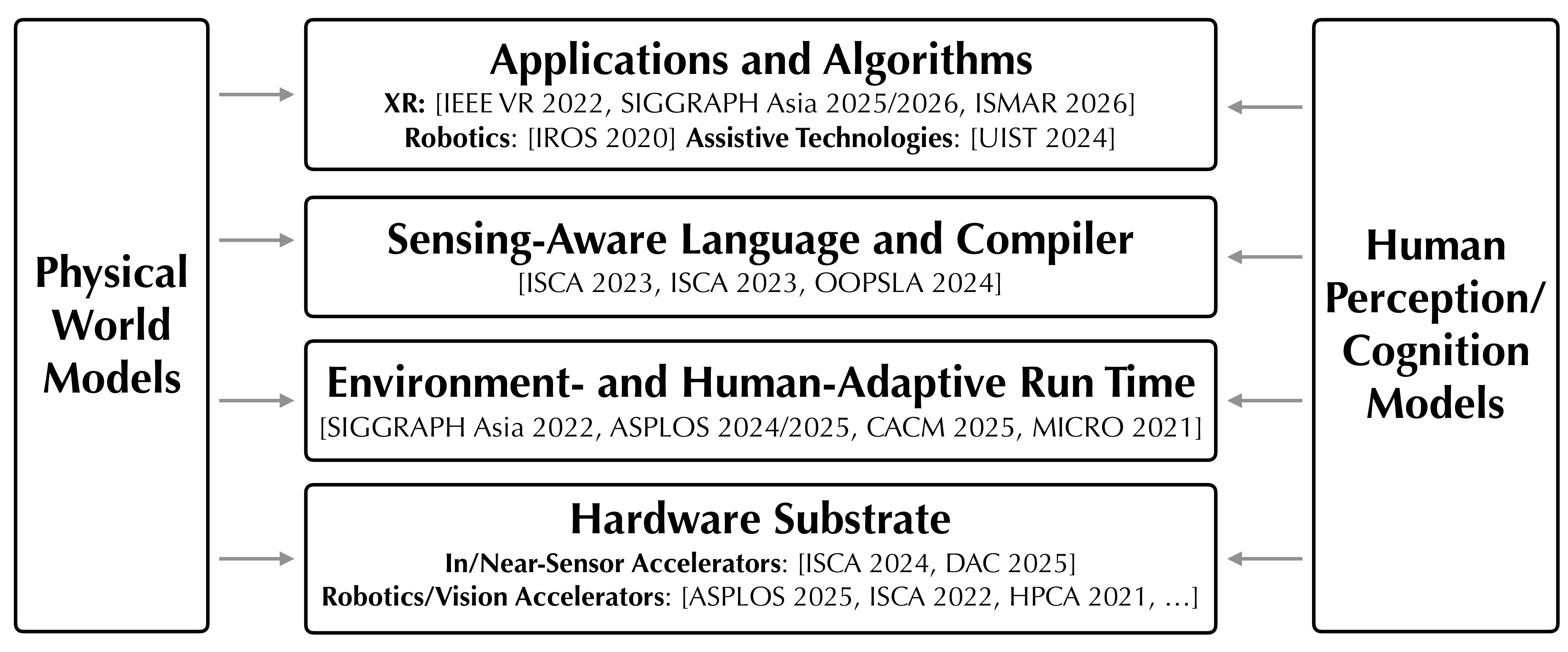
Two characteristics of emerging applications such as extended reality (XR), embodied/physical AI, and autonomous agents are reshaping the foundations of computer systems design:
- First, computing systems will increasingly sense and interpret the physical world, pushing computation beyond digital processors into optics, sensors, and analog circuits.
- Second, computing systems increasingly interact, and collaborate, closely with humans. Human perception and cognition impose constraints on system design while also revealing opportunities to reduce computation, communication, and energy consumption.
We address these challenges by co-designing programming languages, run-time systems, and hardware architectures. Critically, we build and translate models of the physical world and human perception/cognition into principled abstractions, and use these new abstractions to design software and hardware techniques across the physical-to-digital stack.
Related Publications
SIGGRAPH Asia 2026
SIGGRAPH Asia 2026
DAC 2026
DAC 2026
ISMAR (TVCG) 2026
SIGGRAPH Asia (TOG) 2025
SIGGRAPH Asia 2025
Optical Express 2025
DAC 2025
ISCA 2025
ISCA 2025
ASPLOS 2025
ASPLOS 2025
TACO 2025
CACM 2025
WACV 2025
OOPSLA 2024
CACM 2024
ICCAD 2024
ICCAD 2024
TACO 2024
ISCA 2024
ISCA 2024
ASPLOS 2024
SIGGRAPH Emerging Tech. 2023
ICCAD 2023
ISCA 2023
ISCA 2023
DAC 2023
Optical Express 2023
WACV 2023
SIGGRAPH Asia (TOG) 2022
IEEE Wireless Comm. 2022
ISCA 2022
ISSRE 2022
ICCAD 2022
IEEE VR 2022
PPoPP 2022
TC 2022
MICRO 2021
Applied Optics 2021
IEEE CAS-M 2021
RTAS 2021
HPCA 2021
MICRO 2020
MICRO 2020
IROS 2020
PACT 2020
FPGA 2020
MICRO 2019
MICRO 2019
ISCA 2019
CAL 2019
ISCA 2018
APSys 2018
IEEE Micro 2017