Overview
Everyday-wearable Augmented Reality (AR) glasses must meet strict power limits, making displays a key target for optimization. We cast display power optimization as a power-constrained tone-mapping problem and propose a human-vision–grounded, learning-based framework that maximizes perceptual quality under a given power budget.
We introduce an optimization-friendly tone-mapping operator (TMO) parameterization along with a progressive optimization strategy to effectively navigate the quality-vs-power landscape. We distill the iterative optimization into a lightweight feed-forward neural network for real-time deployment. Subjective experiments show that our method yields better perceptual quality than prior work at the same power budget.
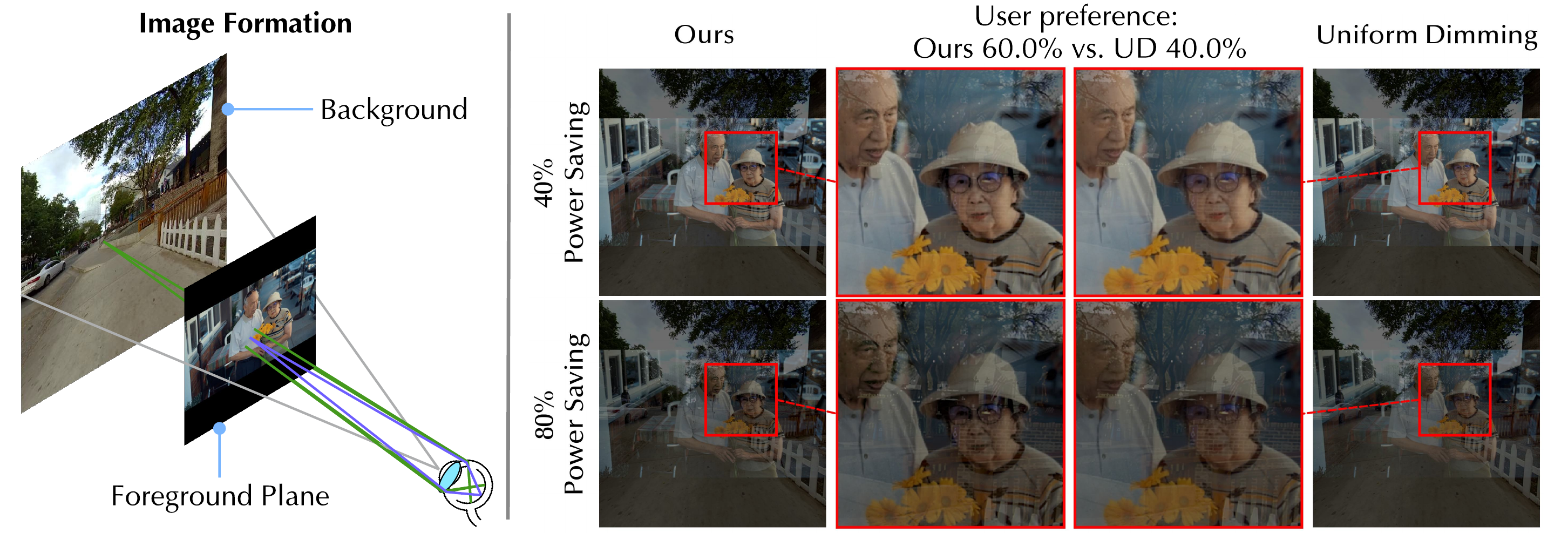
Teaser Video
Image Examples
Visual comparisons against baselines across different power budgets and foreground-to-background luminance ratios. The annotated throughput was measured on an NVIDIA Jetson Xavier AGX.
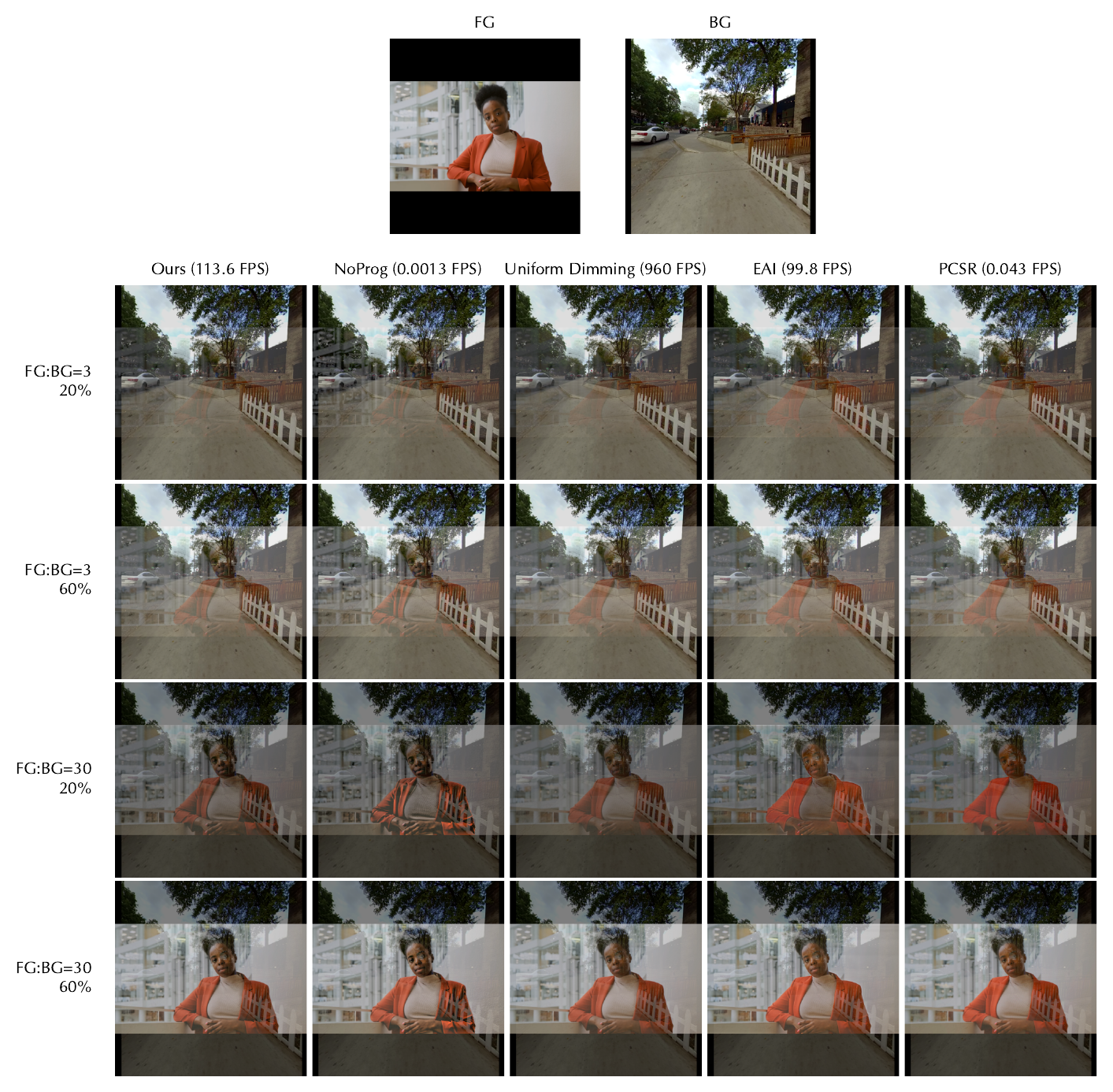
Select an image below to view it as the main result.
Video Examples
LowPowAR can be applied to dynamic content and runs in real time. These examples span communication, social media, video playback, and browsing tasks.